



Indian dairy cooperatives have played a stellar role in transforming the country into a milk-rich nation, and today is the perfect day to thank them. Milk has always been central to human nutrition, from infancy to old age.
To honor its significance, June 1 is celebrated globally as World Milk Day, a tradition started by the Food and Agriculture Organization of the United Nations in 2001. This day recognizes milk not just as food, but as a symbol of nourishment, economic resilience, sustainability, and rural livelihood. The 2025 theme, “Let’s Celebrate the Power of Dairy,” highlights milk’s role in supporting people, communities, and economies.
It’s also a day to recognize the success of India’s dairy cooperatives in taking the nation from milk scarcity to global leadership. In 1950-51, India’s per capita milk availability was only 124 grams per day.
The turning point came in 1965 with the creation of the National Dairy Development Board under Dr. Verghese Kurien, leading to Operation Flood in 1970. This initiative transformed the sector by establishing over 73,000 cooperatives and ensuring milk supply to 700 towns and cities. India not only became self-sufficient but also began exporting dairy products.
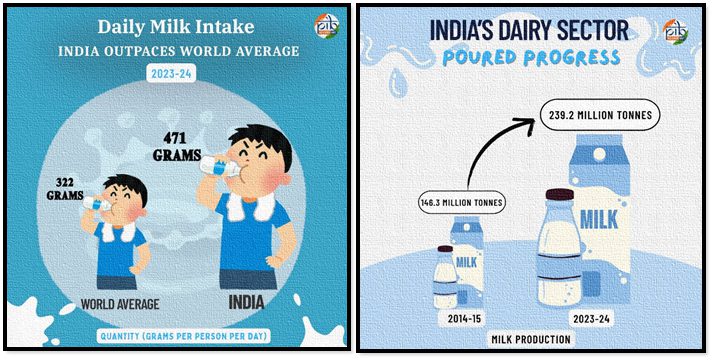
Between 2014-15 and 2023-24, milk production grew from 146.3 million tonnes to 239.2 million tonnes—a 63.56% rise, with an annual growth rate of 5.7%. Uttar Pradesh leads in milk output, while West Bengal has shown the fastest growth. India’s vast livestock base, with 303.76 million bovines and 74.26 million goats, underpins this success.
The cooperative network includes 22 Milk Federations, 240 district unions, and 28 marketing dairies across 230,000 villages, connecting 18 million farmers. Women make up 35% of cooperative members, with 48,000 women-run societies promoting inclusive growth. The dairy sector now contributes 5% to India’s economy and supports over 8 crore farmers.
Government schemes have played a critical role in sustaining this growth. The Rashtriya Gokul Mission enhances indigenous breeds and provides free artificial insemination. The National Programme for Dairy Development builds infrastructure for milk processing and marketing.
The Livestock Health & Disease Control Programme funds mass vaccination and veterinary medicine through its new Pashu Aushadhi component. The National Livestock Mission promotes breed improvement, fodder development, and innovation, while the Animal Husbandry Infrastructure Development Fund boosts private investment in processing units. Since 2019, Kisan Credit Cards have also improved farmers’ access to institutional credit.
India’s dairy revolution is a testament to innovation, cooperation, and farmer-first policies. With continued investment in technology, infrastructure, and sustainable practices, the sector will remain key to building a healthier, self-reliant nation.